This is a question that frequently arises in the spring and early summer. And the answer is usually rust.
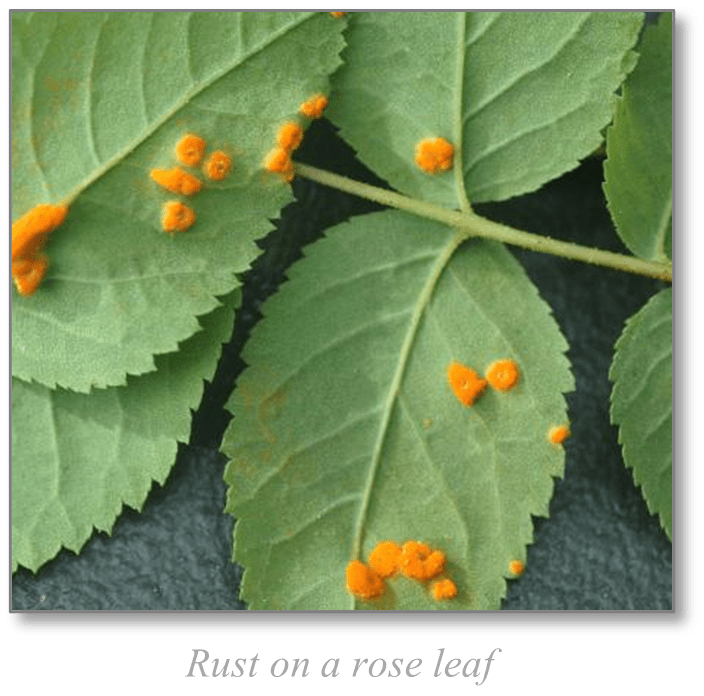
Rust pustules usually appear as powdery yellow or orange spores on leaves and sometimes stems. Some types of rust can also be purple, black, or brown, and depending on the host, the pustules may be on either side of the leaves. Rust infections occur when the plant surfaces are wet and the temperatures are mild. The rust fungi are spread primarily by windblown spores, or when plants are moved from one place to another.
Each species of rust is specific to certain hosts and infects a limited group or just one plant. Most rust fungi have several distinct life stages and complex life cycles which include up to five different spore stages and two distinctly different hosts. Some rusts produce fewer than five types of spores or sometimes only one, and they infect only one kind of plant. Each fungi species can only infect a limited group of plants. Some infect only one species of plant, while others can infect several plants within the same family. Overall, rust species are specialized to specific hosts and have complex life cycles with multiple spore stages.
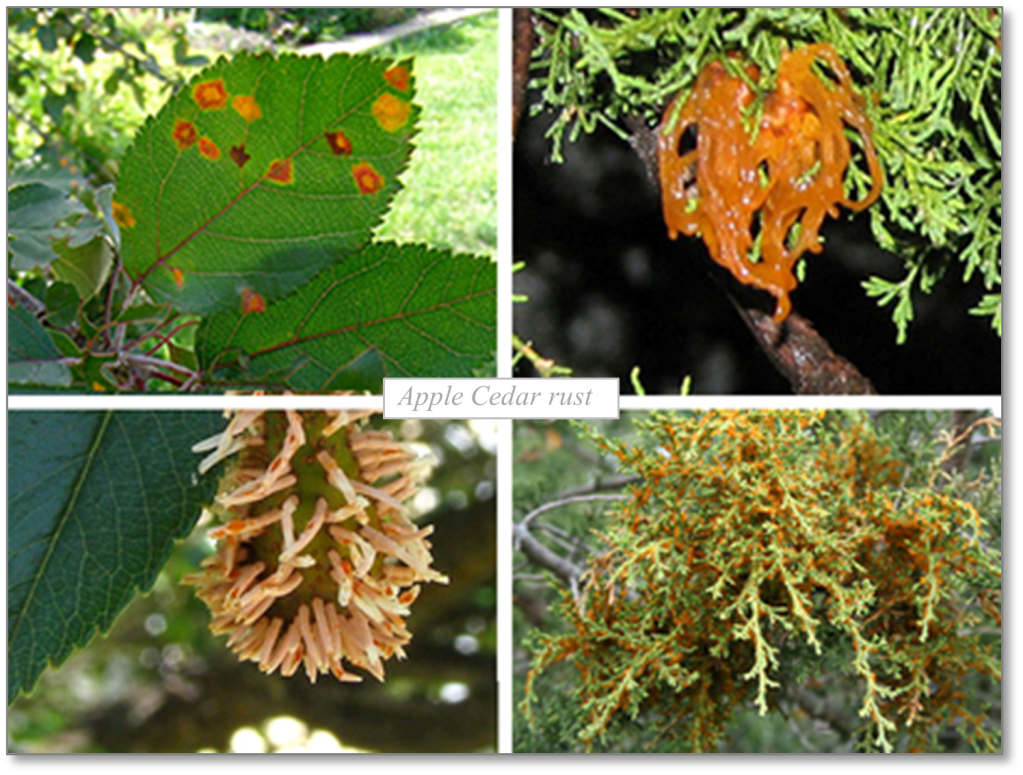
Some rust fungi have an“alternate host”. Alternate host is a host other than the principal host on which the pathogen can survive. Alternate host is used when the principal host is not available. When a rust fungus spends part of its life on one group of plants and the rest on a completely different group of plants, accurate diagnosis becomes more challenging.
Another problem for plants with rust is that they produce urediniospores (repeating spores) that can re-infect the same host that produces them, making them the most damaging phase of most rust diseases.
There are several management options for rust:
- Avoid overhead watering.
- Collect fallen, infected leaves and needles, and dispose of them.
- Cut off and dispose of diseased shoots and branches as soon as they appear.
- Removing nearby alternate hosts of the fungus may help reduce new infections in certain situations.
- Plant rust-resistant cultivars if available.
- Apply fungicides in the spring to prevent or reduce some rust diseases.
Common plants susceptible to rust:
- Roses – no alternate host
- Chrysanthemums – no alternate host
- Hollyhocks – no alternate host
- Karl Foerster ornamental grass – no alternate host
- Apples – alternate host plants, Juniper or Western Red Cedar
- Pears – alternate host plant, Juniper
- Turf grass – common on cool-season grasses
Click here for a printable pdf of this article. Written by Jane Collier, July 2025 photos courtesy J. Pscheidt and WSU
 Clackamas County Master Gardener™ Association