Aphids
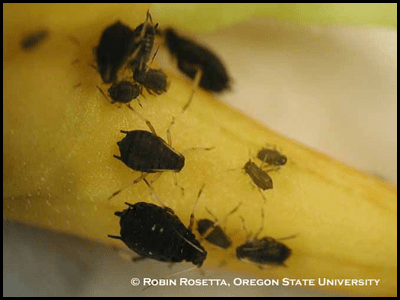
- Aphids feed by piercing and sucking which can cause wilting and yellowing of plant tissue.
- Scout your plants and look on upper and lower leaf surfaces.
- Predators such as ladybugs, lacewings, and syrphid fly larvae feed on aphids, as well as aphid wasps which lay eggs inside aphid bodies.
- A strong spray of water or insecticidal soap can help dislodge aphids.
- Crop rotation for next year is helpful.
To learn more, visit https://agsci-labs.oregonstate.edu/vegnet/pest-profiles/aphids/
Cucumber Beetles
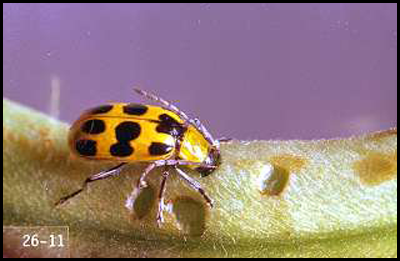
- Adult cucumber beetles feed on foliage of corn, snap bean, cucurbits, potatoes, tomatoes and more.
- Adults overwinter in field borders, then migrate to lay eggs and feed on foliage.
- Larvae feed on roots, pupate in the soil, and emerge again as adults in July and August.
- Sticky traps can be used to monitor for cucumber beetles and as a trap for adults.
- Row covers, trap crops and other cultural control tactics may help to reduce damage to plants, but efficacy varies depending on setting.
- Crop rotation is not an effective measure because cucumber beetles have a wide range of hosts.
To learn more, visit https://agsci-labs.oregonstate.edu/vegnet/pest-profiles/cucumber-beetles-12s-scb/
Flea Beetles
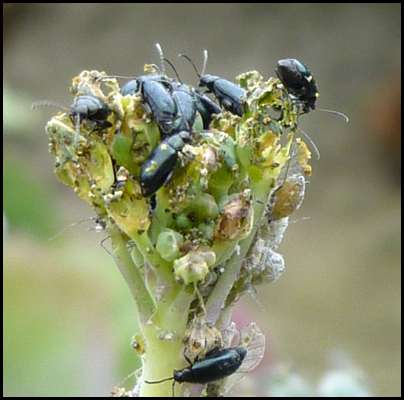
- Both larvae and adult flea beetles chew holes in crops of the Brassicaceae (broccoli, cabbage, kale and relatives) and Solanaceae (tomato, potato, pepper and relatives) families.
- Overwintering flea beetle adults emerge in mid-to-late spring, become more active when the days get warmer, and move into fields as their preferred host plants become available.
- Use yellow sticky traps to monitor the level of population to determine action.
- Use floating row covers to exclude flea beetles from being in contact with crop plants.
- Use trap crops to lure flea beetles away from desired crop.
- Use companion plants such as bunching green onion, dill, and marigolds to make the desired plants less visible.
- Use flowering plants that attract predators and parasitoids (see supporting biocontrol link below).
- Use crop rotation to break the life cycle of flea beetle.
- Keep the area clean of plant debris.
- Remove weeds that can host pests during the winter.
To learn more
Organic Management of Flea Beetles, https://extension.oregonstate.edu/catalog/pub/pnw-640-organic-management-flea-beetles Supporting Biocontrol with Garden Plants https://gardenecology.oregonstate.edu/sites/agscid7/files/gardenecology/biocontrol_f2.pdf
Click here for a printable pdf version of this article. Written by Jane Collier, June 2024. Photos courtesy OSU Extension.
 Clackamas County Master Gardener™ Association