Physiological Leaf Roll
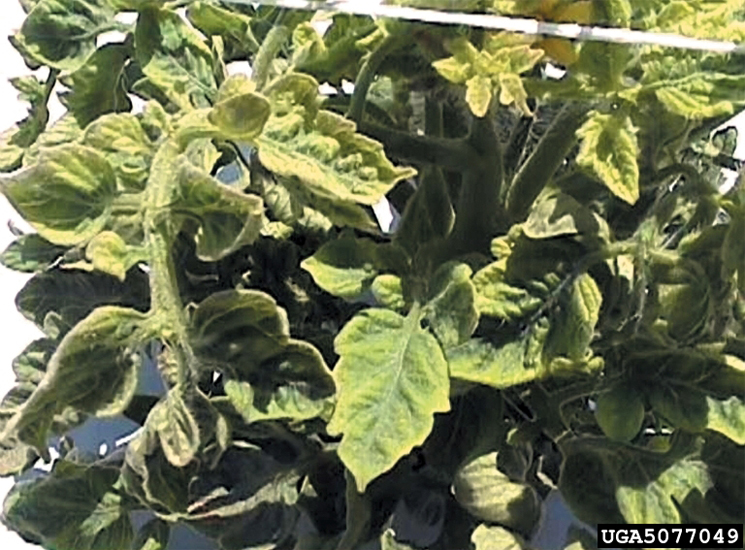
During hot and dry conditions, many gardeners experience what is called “Physiological Leaf Roll.” The symptoms are similar to those caused by certain viruses (curly top and tomato yellow leaf curl).
Physiological leaf roll starts with upward cupping at the leaf margins followed by inward rolling of the leaves. Lower leaves are affected first and can recover if environmental conditions and cultural factors are adjusted to reduce stress.
Current knowledge of tomato physiological leaf roll indicates tomato yield and fruit quality are not affected by this physiological disorder
Management strategies recommended for physiological leaf roll include:
- Planting determinate cultivars,
- Planting in well-drained soils and maintaining uniform, adequate soil moisture,
- Being careful not to over-fertilize (especially with nitrogen fertilizers),
- Avoiding severe pruning, and
- Maintaining temperatures below 95°F by using shading or evaporative cooling.
Physiological Leaf Roll of Tomato, PNW Extension Publication https://wpcdn.web.wsu.edu/extension/uploads/sites/25/PNW616.pdf
Tomato Leaf Rolling, Clemson Cooperative Extension https://hgic.clemson.edu/factsheet/tomato-leaves-rolling/
Blossom End Rot
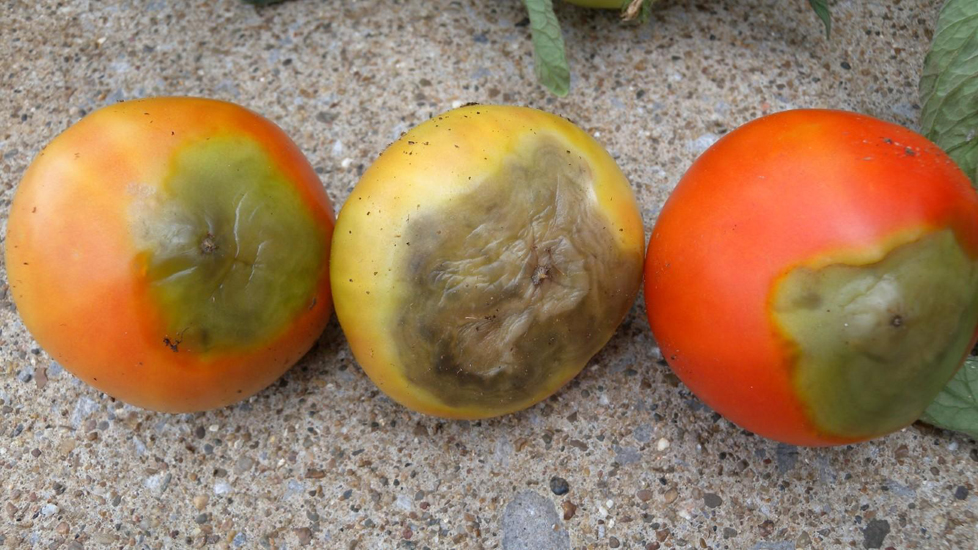
Blossom-end rot appears as a large gray-to-black spot at the blossom end (opposite of the stem) of the affected fruit. It affects immature as well as ripe fruit.
The main cause of blossom-end rot is calcium deficiency at fruit set. This requires that the soil contain sufficient calcium, and the plant delivers calcium to the needed location in the plant. Most of the time, there is enough calcium in the soil, but it isn’t delivered for reasons of 1) Uneven or insufficient watering, 2) Heat snaps with extraordinarily high temperatures, 3) Excess fertilizers, or a combination of all these causes.
To prevent blossom-end rot, get a soil test to ensure soil calcium level is within the recommended range. Use only moderate amounts of fertilizers. Water to a depth of 2 feet and don’t let the soil completely dry out. Restrict cultivation to avoid damaging roots. Use mulch around the tomato plants.
Blossom End Rot on Tomatoes, Oregon State Extension https://extension.oregonstate.edu/sites/default/files/catalog/auto/FS139.pdf
Blossom End Rot, Washington State University https://hortsense.cahnrs.wsu.edu/fact-sheet/tomato-blossom-end-rot/
Blossom Drop

A healthy-looking plant sets flower blossoms, then they dry up and fall off the plant. Blossom drop can be extremely frustrating!
Blossom drop is not a disease. The most common cause of tomato blossom drop is extreme high temperatures. Tomato plants can get stressed if the high daytime temperature is above 85 degrees and the high nighttime temperature is above 70 degrees. Other factors are the lack of pollination, too much or too little nitrogen, lack of water, low humidity and stress from insects or disease.
Temperature and humidity may be out of your control, but you can take these steps to reduce the risk: grow varieties suited to your climate, ensure pollination, go easy on fertilizers and water deeply.
Blossom Drop, University of Washington https://depts.washington.edu/hortlib/pal/on-tomato-blossom-drop/
Tomato Fruit Drop, Clemson Cooperative Extension https://hgic.clemson.edu/why-did-my-tomatoes-stop-producing-fruit/
Sunscald

When tomatoes are exposed to too much sun, it causes soft white or yellow spots on the fruit. Plants with less foliage are more susceptible. To avoid sunscald, be careful with pruning off too many of the upper leaves. If necessary, a lightweight shade cloth can be used.
Tomato sunscald, Washington State University https://hortsense.cahnrs.wsu.edu/fact-sheet/tomato-sunscald/
Sunscald on Tomatoes, University of California https://ipm.ucanr.edu/PMG/GARDEN/VEGES/ENVIRON/tomsunscald.html
Click here for a printable pdf of this article. Written by Jane Collier July 2024
 Clackamas County Master Gardener™ Association