It’s summer. You should be watering your garden and landscape. But how much?
At the north end of the Willamette Valley, gardeners can use the Weekly Watering Number. Every Thursday, the Regional Water Providers Consortium sends participants the number of inches of water needed for lawns and landscapes for the upcoming week to replace the water lost due to evaporation and transpiration from the previous week. This service is provided at no charge.
The information is science-based and accurate down to the zip code level. The number I get each week is different from the number received by gardeners across town, where weather conditions have been a little different. And it is free. I highly recommend it.
How to Sign Up
- Sign up at https://www.regionalh2o.org/water-conservation/outdoor-water-conservation/weekly-watering-number to get a new weekly email, each Thursday, with the inches of water needed for the next week.
- Other parts of the country may have a similar service. Eugene, Oregon, does (https://www.eweb.org/rebates-and-savings/residential-incentives-rebates-loans-and-conservation/water-conservation-tips/weekly-watering-recommendations).
- The state of Utah does (https://conservewater.utah.gov/weekly-lawn-watering-guide/).
- Consult your local water provider to determine if you are missing out on this valuable service.
How to Use the Weekly Watering Number
The weekly Water Number indicates how much water your lawn needs. Your vegetable garden will require about 75% of that amount, while your established shrubs and perennials will need approximately 50%.
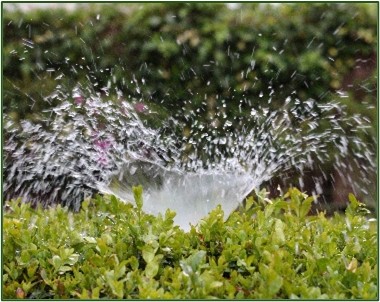
To use the weekly number, you must determine how long your sprinkler system takes to put out an inch of water. You have probably heard of scattering empty tuna fish or cat food cans around your lawn and running your sprinkler system, tracking how long it takes at your usual hose-bib setting to collect ¼” water in the can. Write down the time required and the hose bib setting. This gives you the information to calculate how long to run the system to put down any desired water amount. The time necessary to acquire that measured ¼” will differ if different systems serve different areas.
The weekly water number is for maintenance, reflecting the amount lost last week. If you haven’t watered yet this year, your ground will be drier than that of those who started a month or more ago. You’ll need to catch up before relying on the Water Number for the rest of summer and early fall.
Lawns
Here in the Willamette Valley, we grow more grass seed than anywhere else in the world, and the go-to source of growing information is the turf-grass program at Oregon State University. For years, they, and we as Master Gardeners, have told people that they should water their lawns deeply and less frequently. A few years ago, OSU released new recommendations, based on more than 10 years of rigorous research. The recommendation is different: Yes, you still need 1” to 1.5” per week, but water much more frequently – every couple of days in ordinary summer weather; every day if the temperatures stay above 90 degrees. The frequent watering provides for better turf health than less frequent deep watering.
Trees and Shrubs
Newly planted trees and shrubs need “establishment” watering. This is true even for trees and shrubs listed as “drought tolerant” – they won’t be drought tolerant until they have sent a wide net of feeder roots into the landscape. A good rule of thumb is 5 to 10 gallons of water for every inch of trunk diameter; 2 to 3 times a week from May through October; for 3 to 5 years. Aim to get water down at least 12”, all the way out beyond the dripline. Dig down with a trowel or use a moisture probe to verify. You may find slightly different recommendations from expert sources, but they won’t vary by much; it is always substantially more than new gardeners expect.
“Slow water” your trees using a soaker hose spiraled out from the trunk, or a small portable sprinkler. Soakers are slow – about 0.5 to 1 gallon per foot per hour. A small portable sprinkler will be quicker, but you may have to turn it on and off several times to let the water soak into the soil instead of running off. It’s important to remember that when you first plant that tree, all its roots are within the original root ball, so you need to make a special effort to keep that area moist. Watering the soil outside that original root ball will tempt new roots to spread.
Established trees should be watered deeply once a month during the summer. Even trees native to this area or listed as drought-tolerant are now struggling with hotter, drier summers. Exceptions are Madrones and established White Oaks (Quercus garryana). Do not irrigate them during the summer because watering quickly spreads toxic diseases that can kill these trees.
Mulch
Mulch around your landscape plants and trees. This will reduce evaporation loss from the soil and average out the day-night soil temperatures, providing a much, much happier environment for your plants. For tips on types and uses, see the 10-Minute U handout listed in the resource section.
Watering Zone
Group plants with similar water needs together. Rhododendrons, dogwoods, and many ornamental trees should be planted together. Once established, Ceanothus, manzanitas, and smoke trees (Cotinus coggygria) need less water, so place them in a different “watering zone”.
Resources
Regional Water Providers Consortium with Weekly Watering Number for the north Willamette Valley: https://www.regionalh2o.org/water-conservation/outdoor-water-conservation/weekly-watering-number
10-Minute University handouts:
• Lawn Care https://cmastergardeners.org/wp-content/uploads/2023/04/lawn-care.pdf
• Make Your Garden More Climate-Resilient: Water
https://cmastergardeners.org/wp-content/uploads/2023/10/garden-climate-resiliency-water_.pdf
• Gardening with Mulches
https://cmastergardeners.org/wp-content/uploads/2022/02/gardening-with-mulch.pdf
10-Minute University video: Climate Friendly Lawns https://www.youtube.com/watch?v=lzKxGyWcRpw&t=2s
Click here for a printable pdf of this article. Written by Justin Dune, June 2025. Photo courtesy of Axxl via Pixabay
 Clackamas County Master Gardener™ Association