Five things are essential for fruit tree care during the summer. They are watering, fertilizing, monitoring for pests & diseases, thinning fruit, and summer pruning. This article focuses on four of them, leaving out pest and disease issues. If you encounter such problems, consult the Extension publication in the resources section and/or contact your local Extension office for help.
Watering
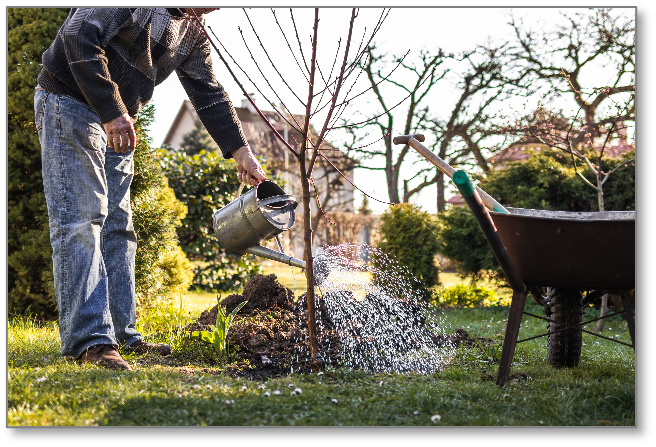
Fruit trees need water to grow roots, shoots and fruits. When watering fruit trees, give them a good soak by saturating the root zone down to 2 feet or deeper. Finish the watering session after digging down 2 feet to confirm that water penetrated to that depth.
It isn’t easy to determine the weekly water quantity for your fruit tree. The type of soil, weather conditions, the age of the tree, whether the root zone is mulched, and many other factors affect the answer. An intuitive way to think about watering is to replace what is lost through soil evaporation and plant breathing. The sum of these losses is referred to as evapotranspiration (ET). Watering should replace ET loss to support the tree’s growth.
In western Oregon, fruit trees need supplemental irrigation during the dry season. That is likely to begin sometime in June and last through September. During that period, they require a deep soak periodically, perhaps every 10 days or longer for sandy soil, and every 2 weeks or longer for clay soil.
Relying on a fixed watering schedule is less dependable than checking soil moisture. Check your soil moisture once a week, or more frequently during heat waves, to determine if it’s time to water. You can use a moisture meter. For do-it-yourselfers, the USDA publication, “Estimating Soil Moisture by Feel and Appearance,” offers a simple method: Dig 6 inches or deeper for a handful of soil. Place it in your palm. Gently squeeze it, then compare its appearance to photos in the publication. You should water the tree when the soil moisture is at or below 60%.
Paying attention to watering will lead to higher-quality fruits. Moisture in the soil helps move water, nutrients, and growth hormones from the soil through tubes called xylem to support fruit development.
The best time to water is early in the morning when both the temperature and the evaporation rate are low. Deliver a low flow of water to the root zone, keeping in mind that active roots are not near the trunk but near the drip line. Focus your attention on the areas where active roots are present. A drip system, soaker hose, or buckets with small holes drilled on the side all do the job.
In Oregon’s northern Willamette Valley, a consortium of regional water providers offers a subscription service to residents who wish to know their weekly ET number. This number indicates the amount of irrigation that will replace water loss during the previous week. Although this number is used for watering lawns, shrubs, and vegetables, it serves as a point of reference for watering trees.
Water well ahead of a heat wave. Remember to take care of your trees after harvesting. Late summer and early fall are critical times for many fruit trees. Be sure they get enough water as they grow new fruit buds for next year and store carbohydrates for winter.
Fertilizing
Experts recommend fertilizing your tree twice a year, with a heavier application in the spring and a lighter application in the fall. Fruit trees have two active growing periods. In the spring, they grow new roots, shoots, flowers, and fruits. After harvest, a second growth period sets the stage for the following year.
In mid-to-late summer, spread a thin layer (1-2”) of compost over the root zone. That is sufficient. Compost acts as a slow-release form of nitrogen fertilizer, which minimizes the risk of nutrient loss through irrigation runoff. In Western Oregon, soils tend to contain sufficient potassium and phosphorus so adding nitrogen may be sufficient.
Fertilizing is critical for young trees, less so for mature trees that show healthy growth. Some Extension publications also recommend adding boron and other trace minerals. If you haven’t tested your soil, it’s a good idea to invest in a soil test so you know what is needed.
Fruit Thinning
All stone fruits (peaches, apricots, nectarines, plums, cherries, etc.) and most pome fruits (all apples, all Asian pears, and most European pears) need thinning. Fruit thinning offers several benefits:
- Improves the quality of remaining fruits
- Allows the tree to produce an annual crop and avoid “alternate bearing,” which is when a tree makes a bumper crop one year and nothing the following year
- Maintains tree health
- Avoids broken or misshapen branches caused by a heavy fruit load

Thin stone fruits when they are .75 inch to 1 inch in diameter. Thin pome fruits between .5 inch and 1 inch in diameter. What if you haven’t had time to thin until the fruits are larger? Go ahead anyway. You won’t reap the full range of benefits, but it still serves tree health.
Fruits often naturally fall from the tree in June. Check your tree after the June drop to see if further thinning is necessary. Use these distances as a guide: apricots and plums should be 2-4 inches apart, nectarines should be 3-5 inches apart, peaches should be about 6 inches apart, and apples and pears should be thinned to 1 or 2 per cluster, with clusters on the same shoot spaced 6-8 inches apart.
Summer Pruning
Fruit trees should be pruned in both winter and summer. For mature trees, summer pruning involves removing upright, vigorous branches, often called watersprouts, as well as heading or thinning shoots.

Summer pruning is best done in August–September when most lateral branches develop a terminal bud. Carefully inspect each branch. Those with new leaves and those that are growing longer are still actively growing and are not ready for summer pruning. Lateral branches with a fat bud at the tip of the branch have stopped growing. They are ready, and summer pruning will stimulate little to no new growth.
I follow Orin Martin’s recommendation for summer pruning. His system is based on the French orchardist Louis Lorette. It calls for keeping the weaker laterals and removing the vigorous ones, using the length of the lateral branch and its angle as indicators of vigor. Long, vertical branches are vigorous; shorter laterals (< 8–9”) grown at an angle or horizontally are weaker. In addition, laterals are thinned to 7–9” apart. Martin’s book, Fruit Trees for Every Garden, provides detailed information.
When pruning, leave weaker laterals untouched and only cut back the stronger ones. Remove all vertical, vigorous shoots except for those saved as replacements. Shorten a long branch to three buds from this year’s growth. The top bud will continue to grow and extend slightly. The next two buds might develop into fruit buds and produce fruit within a year. An additional benefit of cutting back laterals is that they will be shorter, thicker, and better able to support the weight of the fruit without sagging or breaking.
Summer pruning is essential for the health of stone fruits like apricot, cherry and peach. For them, winter pruning gives common pathogens an ideal opportunity to attack. Pathogens are less of a concern for pome trees if pruned in the winter. However, winter pruning stimulates vigorous growth, which summer pruning doesn’t. If you’ve done most of your fruit tree pruning in winter, I recommend trying summer pruning this season.
Resources
Growing Tree Fruits and Nuts at Home, EC 819, Oregon State University https://extension.oregonstate.edu/catalog/ec-819-growing-tree-fruits-nuts-home
Estimating Soil Moisture by Feel and Appearance: https://www.nrcs.usda.gov/sites/default/files/2022-09/Estimating%20Soil%20Moisture%20by%20Feel%20and%20Appearance.pdf
Managing diseases and insects in home orchards, OSU Extension Publication EC 631: https://extension.oregonstate.edu/catalog/ec-631-managing-diseases-insects-home-orchards
Fruit Trees for Every Garden, Orin Martin, 2019, Ten Speed Press
Click here for a printable pdf of this article. Written by Sherry Sheng, July 2025
Photos: Watering courtesy Canva, Thinning courtesy S. Andrews, Pruning courtesy J. Collier
 Clackamas County Master Gardener™ Association