The OSU Garden Ecology Lab (Lab) is advising gardeners to use plants for natural biological control of garden pests. The Lab’s research in Oregon’s Willamette Valley shows that several garden plants attract a high number and variety of insect predators and insect parasitoids. Find details in Supporting Biocontrol with Garden Plants by clicking here: Supporting Biocontrol with Garden Plants
Use Beneficial Insects to Control Garden Pests
Predators, parasitoids and pollinators are three major types of beneficial insects. Predators eat a large number of other insects which keeps down the level of pests. Some examples include lady beetles, praying mantises, lacewings, ground beetles, minute pirate bugs, damsel bugs and syrphid fly larvae.
Parasitoids are insects that live on or in a host insect, feeding on the host and usually killing it over time. Common beneficial parasitoids are small stingless wasps, tachinid flies and large wasps (ichnuemonid or braconid). These wasps don’t sting people, but instead, sting other insects so that they can lay their eggs on or in the other insect. Many cannot be seen, but others are quite impressive to see (great golden digger wasp, for example). Research shows they have an important impact on pest insect populations.
Encouraging the presence of predators and parasitoids lessens the need to control harmful insects. While purchasing and releasing biocontrol agents work well in enclosed areas, we do not recommend this approach for gardens. Adding plants proven to attract predators and parasitoids is a superior approach.
Top Five Biocontrol Native Plants
Field study of the Lab found Douglas’s aster (Symphyotrichum subspicatum) attracts the largest number of natural enemies. “Natural enemy” is the term scientists use when referring to predators and parasitoids. A separate analysis showed 74 species of bees use this aster, more than 9 times the number of bee species that visit lavender.
Rounding off the top 5 plants that have proven to possess superb abilities to attract natural enemies are Canada goldenrod (Solidago canadensis), Yarrow (Achillea millefolium), Farewell-to-spring (Clarkia amoena) and Pearly everlasting (Anaphalis margaritacea). Doug Tallamy & National Wildlife Federation’s Keystone Native Plants include both Solidago and Symphyotrichum for the Northwestern Forested Mountains Ecoregion. See details at Keystone Plants by Ecoregion
Finding Plants
While these plants are easy to grow, finding the native plant or seeds may not be easy. Using yarrow as an example, cultivars with vibrant blooms in gold, terracotta and red., are ubiquitous in the trade but the species may only be available at a native plant nursery or as seeds. Get tips for how to buy a native plant from this Lab brief: How to Buy a Native Plant
This study of pest control abilities used the straight species, not cultivated varieties with bigger, more colorful flowers. In a separate study, Lab researchers found the native plants nearly always superior at attracting native insects over cultivated varieties. Is there a difference between their biocontrol prowess? We don’t know without more studies.
Growing Tips
These native plants are adapted to dry summers and require little supplemental water after the first season after planting. Their resilience, however, has a downside – these strong growers have the ability to spread via roots or seeds. To reduce undesired spread in the garden, plant into areas where soil is poor (not amended, containing lower levels of organic matter) and does not receive regular irrigation. Monitor to keep them in check.
Douglas’s Aster

- 2-3’ high, taller with regular irrigation, upright
- Blooms July to September with daisy-like flowers in white or lavender
- Full sun to part shade
- Dry to wet soil
- Perennial. Spread via creeping rhizomes to form a larger clump. It can also self-sow from seeds.
- Can start from seeds, plant or root division
- Native to Alaska, Washington, Oregon and California, and into Idaho and Montana. In the wild, found in forests, along the banks of streams, and even along the coast.
Canada Goldenrod
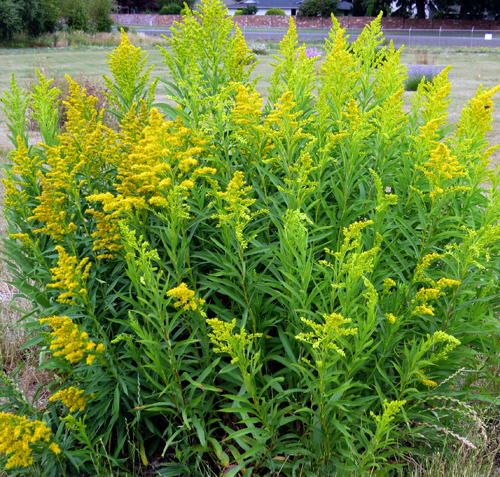
- 3-4’ high, upright
- Blooms in mid-summer with small, golden flowers
- Full sun to part shade
- Dryish soil
- Perennial. Plants can be established by seeds, seedlings or rhizomes. Spread via rhizomes into large clumps.
- Native throughout most of North America with great regional variation
Yarrow
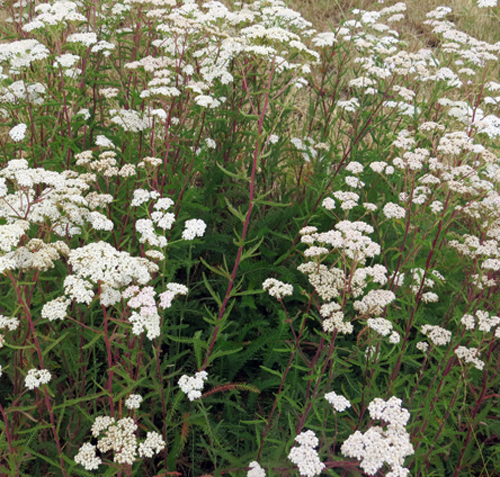
- 8-16” high, single or multi-stems grown from a fibrous root
- Blooms in May to June, yellowish-white flower has a flattish dome shape
- Full sun to light shade
- Does well in poor, dryish soil with good drainage
- Perennial. Can start from seeds or plant
- Native throughout the United States. In the wild, it is found in open, mildly disturbed areas.
Farewell-to-Spring
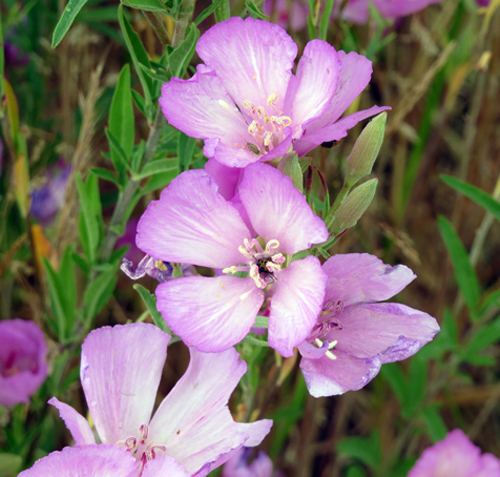
- ½-3’ high, upright stems
- Blooms late spring to mid-summer with pink, cup-like flowers
- Full sun to light shade
- Dryish soil. Rich moist soil may cause the plant to become leggy and need support.
- Annual. Direct sow seeds in the fall or spring, or purchase seedling from nursery. Established stands may perpetuate by self-sowing.
- Native to coastal areas from British Columbia to California and in the Columbia River Gorge
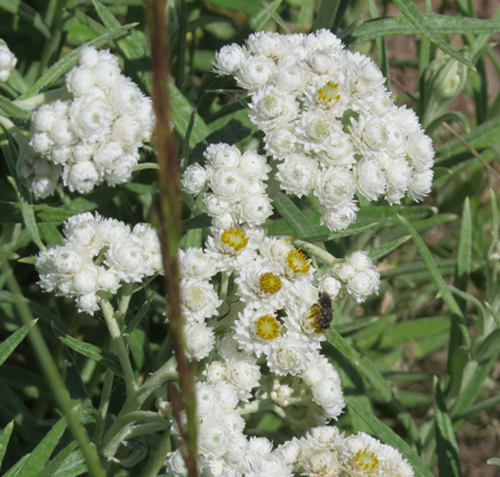
Pearly Everlasting
- 1-3’ high and up to 2’ wide
- Blooms in the summer, yellow disk-flower center surrounded by pearly-white bracts
- Full sun to part shade
- Drought tolerant. Does well in dryish, lean soil
- Perennial. Plant seedlings or direct sow seeds in late fall or winter. Can spread via runner.
- Native to most of the continental United States and Canada.
- Host plant for American lady and painted lady butterflies.
Ideas for Garden Use
- Douglas’s aster and goldenrod are ideal for natural-looking gardens where they are allowed to form large stands.
- Yarrow, farewell-to-spring, pearly everlasting are good candidates for informal-looking gardens where they are grown in groups for visual impact.
- To control spread, place them next to natural containments such as the sidewalk or a path.
- Taller plants such as goldenrod and Douglas’s aster are often placed in the back. Shorter plants tend to be placed in the front of a border.
- If you enjoy watching insect activities, place a plant in the front as a specimen and watch the ‘insect truck stop’ in action.
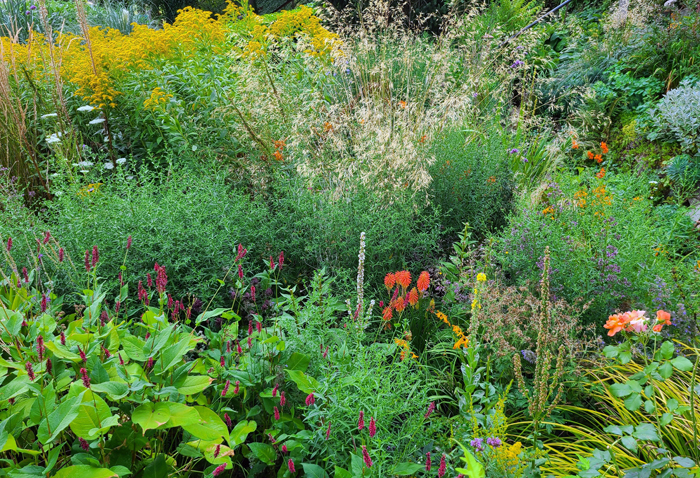
Douglas’s aster are in large drifts in front and will bloom two weeks later.
Click here for a printable pdf of this article. Written by Sherry Sheng, photos by Sherry Sheng – July 2024
 Clackamas County Master Gardener™ Association